Showing posts with label Amy Bissell - Evaluation. Show all posts

Wednesday, 18 April 2012

Amy Bissell - Critical Evaluation - Question 1


Q1: In what ways does your media product use, develop or challenge forms and conventions of real media products?

We had planned from our initial brief to make our film fit the romantic comedy genre.  We each took part in researching into elements of genre, such as romance, drama, romantic comedy and comedy itself to give ourselves an in-depth knowledge of what an audience expects to find in each. We found that romantic comedy was quite a typical genre and has a familiar structure, (See Below).  Although elements of our film fit to this structure, (boy meets girl, conflict, obstacles) it also contradicts the genre, as there is no real threat to the couples’ relationship and there appears to be no happily ever after at the end. Romantic comedy is not the only genre our film fits. Theories like Steve Neale’s believe that genres are interlinked as hybrids. Although not totally apparent, our film is a hybrid of romantic comedy and science fiction (a.k.a. Sci-Fi) with the frequent use of possible future technologies.


To plan, we first brainstormed as a group to choose collectively basic plot and structure of our film. We took our research into genre further by watching clips of romantic comedies to study the locations, characters, costumes and overall editing. I choose to study a clip from “50 First Dates” (See Below). Influence from films like “50 First Dates” and “Click” gives our film intertextuality. We also researched into short films on websites such as ShortsBay to see what makes a short film.


We edited our film on Final Cut Express. Our film features a large number and variety of jump cuts to make longer periods of time in our film pass by quicker as we only have a restricted 5 minutes. Our film also has a non-linear narrative, starting in the middle of the story, cutting back to the start of their relationship, and finishing with the end. To make the transitions more fluent, we added video transitions and some freeze-frames with voiceovers. We also used a combination of music and voiceover to create a montage to make the passage of time quicker and more fluent. We also used Final Cut to alter the speed of our film in the “rewinding” scenes, we simply selected the footage we wanted to play backwards, went to the “Motion” tab, select “Speed”, changed the duration to the desired speed, usually around 2 seconds, and then select “Reverse”. To make it more realistic, we also added sound effects from royalty free websites like SoundJay, of a cassette tape rewinding.  We maintain continuity while editing by keeping to the 180-degree rule in our shot reverse shot scenes, and also edited the lighting by adding filters to alter colour and brightness. These filters made the transition between shots seamless even though they were filmed on different days and at different times.


Our film aims to make a statement about todays world, in terms of technology and relationships. First with the remote and its effects on the universe. When does technology go too far? When is enough, enough? We hope our audience will question whether they would like a remote like the prop themselves to remove mistakes or would they rather be liked in a relationship regardless of imperfections. The remote is used as more than a prop, but as a symbol for todays’ society and the image of perfection we are obligated to fit. Buscombe theory of inner and outer forms of genre relates to our films sci-fi elements. Although the remote serves as an outer form, a prop as a visual convention for the underlying sci-fi element of our film, it also serves as an inner form to express the moral of the story. Hopefully, after seeing the disappointment of the characters after the effects of the remote, the audience will come to the conclusion that perhaps the remote is not the answer. Our film also challenges the idea that men hold more power over women, particularly in film.  Although our lead character is male, he is portrayed as a vulnerable character, at the mercy of the female, and although he is control of the remote, she has control over the date. It challenges the conventions of film. But in the end, both characters are revealed as vulnerable, as she has a remote as well. This relates to Rick Altman’s theory of semantic, syntactic and pragmatics as it features elements of all three:
-  Semantics – visual conventions of the genre. (Boy meets girl, date situation of having dinner, flowers.)
- Syntactics – expectations/ideals of the narrative. (Power struggles of relationships, sexual under theme, the search for love)
 - Pragmatics – influence of audience/institutes. (Power struggle between men and women where the male has the upper hand – however in the end we have equilibrium.)

The audience should receive forms of pleasure through watching our film. Richard Dyer’s theory of “Utopian Sensibilities” believes audience seek pleasure for an element they lack in their own life through films. Our film provides:
·      Intensity in its characters alternating moods for those who have a ‘boring’ or ‘mundane life’. 
·      Transparency as our leading male has clear emotions through his facial expressions, dialogue and inner monologue for those tired of ‘lies and manipulation’.
·      Most importantly, community for those who are ‘lonely’, as even though the characters are conflicted, they are both presented as hopeless and in a way, meant for each other, which should give our audience a subtle hope.

The majority of the short films I know have an experimental or educational feel, often used as a form of expression or to give a moral. Some are even used for advertising, such as the short film I analysed called “The Star”, which is an advertisement for Mercedes. “The Star” was quite different for a short film, as it is filled with high profile celebrities, like Madonna and Clive Owen, whereas usually short films have unknown actors due to their budget. It had a male V.s. female dynamic, similar to ours. Ours also has a male/female V.s technology, as does “the Star” where Madonna is at the mercy of the Mercedes and her Driver. It has elements of physical comedy very similar to ours, for example when the Star spills coffee on her trousers, which is mistaken for urine. They use some similar editing techniques to our film, for example they alter the speed of some footage and use overdramatic music for comedic effect.


Amy Bissell - Critical Evaluation - Question 2

Q2: How effective is the combination of your main product and the ancillary texts?

Amy Bissell - Critical Evaluation - Question 3

Q3: What have you learned from your audience feedback?


Amy Bissell - Critical Evaluation - Question 4

Q4. How did you use new media technologies in the construction and research, planning and evaluation stages?
A: Technology has been the most important feature of my product this year. From the initial research to the final edit of my five-minute film, new technology has played a vital role in my work. Firstly, I have used the Internet, using a Blog to exhibit my work and research in a creative format. My blog had multi-media, featuring text, external link, a collection of borrowed and original photos and even videos, both from YouTube and of my own creation. The Internet was vital for my research, in particular to find examples viral advertising, where I found many examples such as images and interactive website.  The Internet also provided opportunities from audience research, as I used the social network site Facebook to gain information through a digital questionnaire via Chat. It enabled me to get a broad audience feedback.  I did however encounter problems when uploading my own video’s to YouTube as our college provides only a restricted bandwidth for uploading, but after consulting my tutor the problem was soon fixed. I also used a variety of software on Mac computers throughout my project. I used Celtx to write the script, Word to create a shooting script, Photoshop Elements to create a banner and Production Company Logo, and ArtTextLite and Paint to create our title. We also used websites like eBay, as we created a fake page advertising the prop remote used in film. Photoshop Elements allowed me to use a range of features to edit different layers, much like Final Cut but for images. I could create a background and build onto it with different layers, like imported images, text layers and then clip art. For sound editing in our film, we used a combination of Garage Band and Final Cut together to create an interesting effect on the sound effect of rewind me used to make it sound echoed, and to compile the sounds effects, music and soundbites effectively.


New technology was a big part of the production stage of my film with the equipment used. We filmed using a high definition camera, which enabled us to create a more crisp image.  I also gained experience using a Zoom Recorder to create original audio for a voiceover. These details helped to create a more technical and advance final product than in my Foundation year. I was however forced to change elements of my film due to restrictions caused by technology, in particular with focus. Our camera uses a spinning ring to focus, rather than a linear ring, which made it very difficult to focus on objects very close to the camera and also when pull focusing. I was forced to remove a pull focus shot from our film and replace it with a simple medium shot of two characters instead. I also found that the camera and tripod restricted me from filming in a confided area, in particular when I was filming in a bathroom that had little space to fit the camera plus various mirrors. To overcome this, I included two hand held shots rather than using the tripod.

To edit the film, we used Mac computers and various software such as Final Cut Express to edit footage and Photoshop Elements for poster design. I also used other software such as using Celtx to create a formatted script. To show creativity, we created our viral advertisement idea to be featured briefly in our film itself. We used Final Cut Express to edit our advert together. I created images for the advert on Photoshop elements which was imported onto Final Cut, where we also added moving text and copyright free sounds from a website. It combined all our new skills together and allowed us to experiment with the features of Final Cut Express before editing our final product, such as altering speed and reversing the images to play backward. In particular, I did the majority of editing in the group on our final product, which involved trimming shots, importing voiceover audio and copyright free sound effects, applying various transition and reversing visuals and audio. I was also responsible for altering the colour and brightness of several shots and also adjusting audio levels. Here is the step by step process I had to complete for each shot to edit the colour and overall brightness of the shot, (Click to Enlarge). First I selected the shot and clicked the filters tab. I then dragged in a Brightness and Contrast filter and adjusted the levels of each. Then I added a colour filter and added more white and blue to countert the overly-yellow image. You see the end result on the final photo.


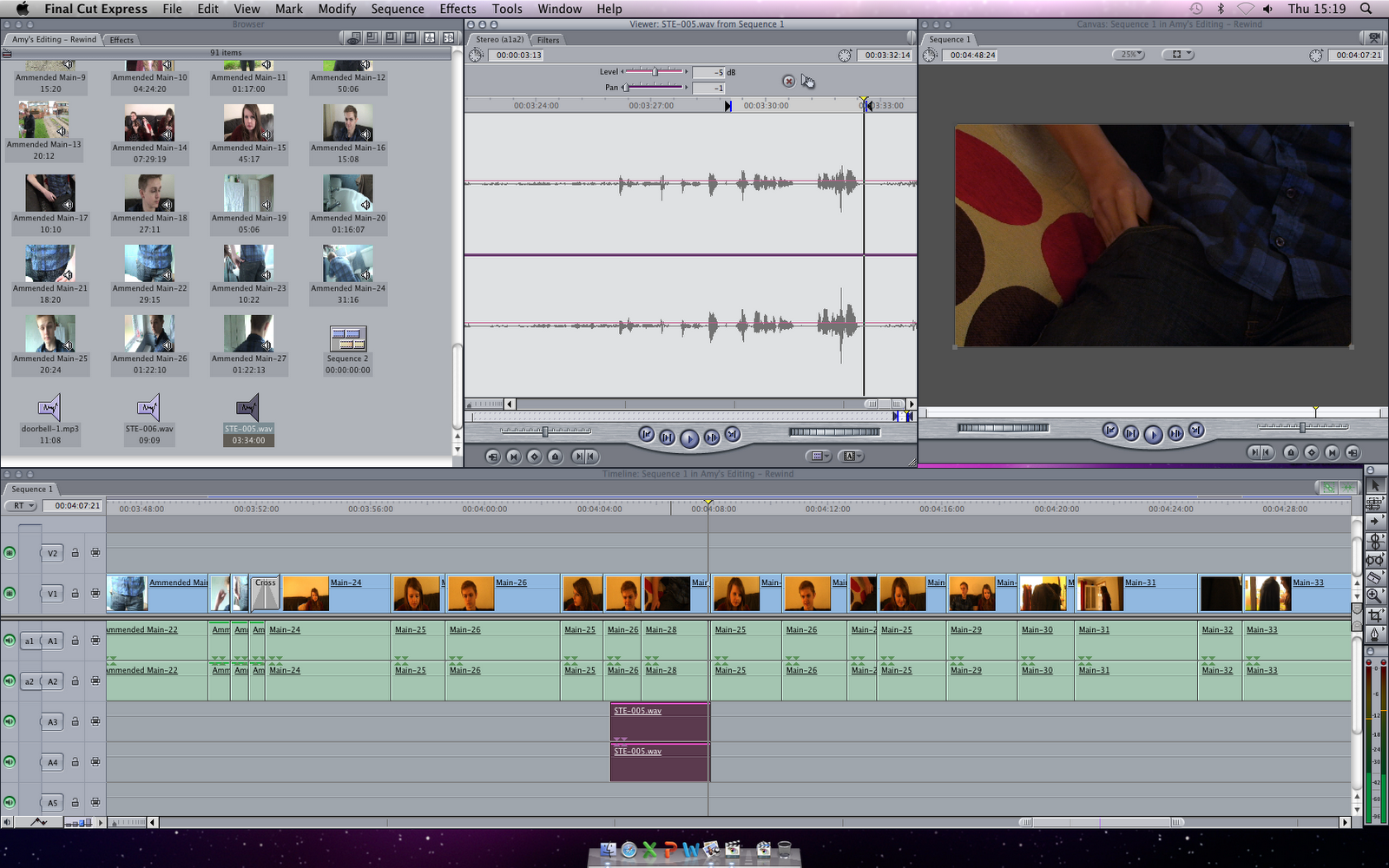
I was also had to alter the audio levels of some shots, for example when adding our voiceover recordings. Here, I altered the Level from 0db to -5db and the Pan from 0 to -1, making the recording quieter.


Some shots were also adjusted using the framewire feature to edit their composition on screen. Below is an example, while I was creating the title sequence which involved editing the wire frame of nine video clips on separate layers. When I decided how big the first would be, I simply copied the number in the "Scale" box on the "Motion" tab so they would all be the same dimension. 


When creating the radio trailer on Final Cut Express and also used Garage Band to edit sound. We selecting a scene which gave a good representation of the plot and themes of our film, selecting the audio to make a sequence (this was now a sound bite), then we added a recorded voiceover which said our tagline, then adding a final layer of music from our film to give the advert synergy to our film. Final Cut made the process very easy as if was easy to cut each audio on its own individual layer. We could also edit the level of volume on each audio to make the voiceover and sound bite over power the music volume. We wanted to add a distorted and echo sounding rewind sound effect, and use Garage Band to alter the sound, then adding it back to Final Cut to make the final product. 


Our poster design was created on photoshop, using original photos and images that were royalty free. We created a  friendly colour scheme to make the advert inviting to show the air of romance in our film, but also had a comedy theme with the context of the actors and what they were doing. We able to edit a photo of our actor into the screen of a television, appearing trapped by using the Photoshop "lasso" tool to remove the background and a "blur" tool to blend them in, giving the final piece a professional feel.